

Magnesium, Done Properly
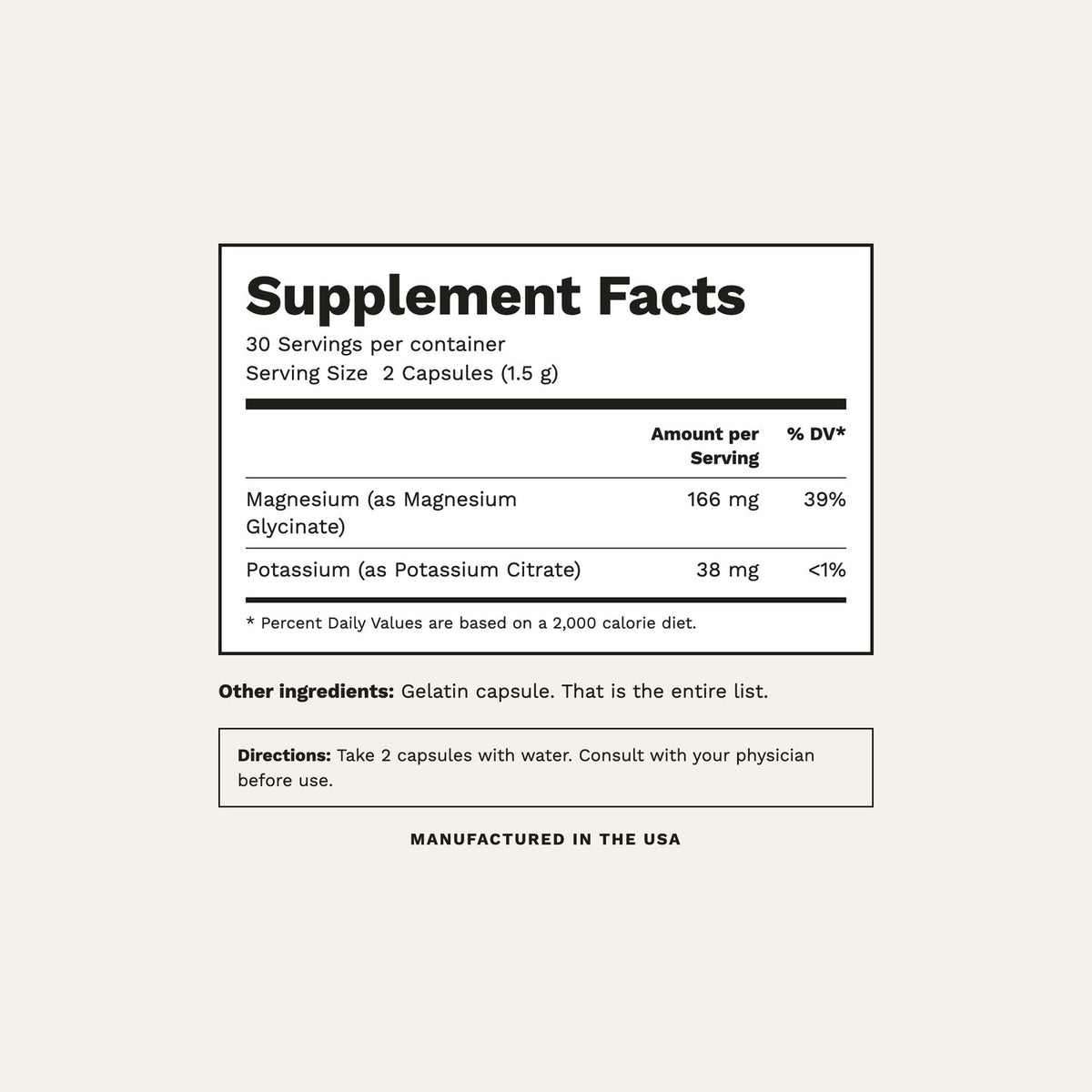
166 mg of magnesium as glycinate, plus potassium citrate, in a capsule whose only other ingredient is the capsule.†


Lingo Magnesium · Magnesium Glycinate + Potassium Caps
Magnesium, Done Properly
166 mg of magnesium as glycinate and 38 mg of potassium as citrate, in two capsules a day. The only other ingredient is the capsule itself.†
BUNDLE & SAVE

Lingo Magnesium · 14-Day Travel Pack
Lingo Magnesium · 14-Day Travel Pack
Couldn't load pickup availability
Order today for delivery by -
Description
Description
Lingo Magnesium is magnesium glycinate with a measured touch of potassium citrate, in a capsule with nothing else in it. Two capsules deliver 166 mg of elemental magnesium (39% DV) and 38 mg of potassium.
No magnesium stearate, no silicon dioxide, no fillers or binders. The other-ingredients line reads: gelatin capsule. 60 capsules, 30 servings, manufactured in the USA.
Why Lingo Magnesium?
Why Lingo Magnesium?
Magnesium is involved in hundreds of reactions in the body: muscle function, nerve function, energy metabolism, normal bones. The NIH Office of Dietary Supplements says plainly that the diets of many people in the United States provide less than the recommended amount, and that adults need roughly 310 to 420 mg a day.
The problem with most magnesium on the shelf is not the idea, it is the execution: oxide, the cheapest and least soluble form, padded out with stearate and silica, with the headline dose hidden behind six capsules. Lingo Magnesium is the other version. Glycinate, the amount printed on the front in the serving on the label, and an ingredient list you can read out loud in four seconds.†
Benefits
Benefits
- Supports normal muscle function†
- Supports a normal energy-yielding metabolism and helps reduce tiredness and fatigue†
- Supports normal nervous-system and psychological function†
- Contributes to the maintenance of normal bones and teeth†
- 166 mg of magnesium as glycinate, not oxide
- 38 mg of potassium as citrate, for the balance
- No fillers, no binders, no magnesium stearate, no silicon dioxide
- Two capsules a day · 60 capsules · made in the USA
Recommended Use
Recommended Use
Take 2 capsules with water. Consult with your physician before use. Take them at whatever time of day you will actually remember; many people prefer the evening.
One bottle is 30 servings, so thirty days is a fair test. Do not exceed the recommended serving: with magnesium, more is not better.
Warnings
Warnings
Consult your physician before use. Speak to your doctor first if you have kidney disease or reduced kidney function, are pregnant or nursing, or take medication — magnesium can interact with certain antibiotics, bisphosphonates, diuretics and proton pump inhibitors, and the potassium matters if you take a potassium-sparing diuretic, an ACE inhibitor or an ARB. Stop use and see your doctor if you notice any adverse reaction. Contains gelatin. Keep out of reach of children. Do not exceed the recommended serving.
Do You Offer a Guarantee?
Do You Offer a Guarantee?
All Lingo Magnesium orders are backed by our 30-day money-back guarantee. If you're not completely satisfied, simply contact us — we'll make it right, no questions asked.

Lingo Magnesium · Magnesium Glycinate + Potassium Caps


The Form That Gets In.
Nothing Else in the Capsule.*
Most magnesium on the shelf is oxide, padded out with fillers and flow agents. This is glycinate, with the ingredient list you could read out loud in four seconds.
Try Risk-Free TodayTwo Ingredients. Both on the Front.

The mineralMagnesium Glycinate
166 mg of elemental magnesium per serving, bound to glycine. Magnesium contributes to normal muscle function, normal nerve function and a normal energy-yielding metabolism, and helps reduce tiredness and fatigue.†

The balancePotassium Citrate
38 mg of potassium. A small amount on purpose: potassium should come mostly from your plate. It is here because magnesium and potassium work alongside each other, not to replace vegetables.†

The capsuleGelatin. That's All.
No magnesium stearate. No silicon dioxide. No rice flour, no microcrystalline cellulose, no "proprietary blend". Turn the bottle around and the other-ingredients line is one word long.

The routineTwo Capsules, With Water
Two a day is the serving on the label. Many people take them in the evening, simply because that is when they remember. No powder to mix, no taste, no four-pill handful.
Honest note: magnesium supplements are not a treatment for any condition, and most people who eat a varied diet already get a reasonable amount. The NIH Office of Dietary Supplements puts it plainly: "The diets of many people in the United States provide less than the recommended amounts of magnesium," and also that when food and supplements are combined, "total intakes of magnesium are generally above recommended amounts." Both sentences are true. This is a supplement, not a diagnosis.
Why People Start Taking It
Nothing dramatic. The reasons people give us, in their own order.
Legs that stay tight
The calves and hamstrings that never quite let go the day after a session, and the cramp that wakes you at two in the morning.
A mind that will not switch off
Body tired, head still going. Magnesium contributes to normal nervous-system function, which is why it is the mineral people reach for at night.†
"But I eat really clean"
You can log a genuinely good diet and still land short on magnesium, which is why people who cook from scratch are often the ones who end up supplementing.
If cramps, palpitations, persistent fatigue or a racing mind are new, severe or getting worse, that is a conversation with your doctor, not a bottle. Magnesium is also one of the minerals that matters if you have kidney problems or take certain medications, so check first.
Two Capsules. Every Day.
What magnesium is officially recognised to do, in the words the science supports.

Plain Facts. No Miracle Numbers.
What is actually established about magnesium, and where the honest edges are.
How much you need310 to 420 mg a day for adults.
Why the form mattersGlycinate versus oxide.
 The soil argumentPopular, and only partly settled.
What is not in itThe other-ingredients line.
 lingo
lingoYour First Bottle
One bottle is thirty days at two capsules. Minerals are not a stimulant: there is nothing to feel in the first hour, and that is exactly how it should be.
Days 1–7: The Habit
- Two capsules with water, at the time you will actually remember*
- No taste, no powder, nothing to mix*
- Gentler on the stomach than oxide, which is the usual complaint*
Weeks 2–4: Topping Up
- You are closing a gap between your plate and the recommended intake*
- Many people say the evening wind-down is where they notice it first*
- Keep eating the greens, nuts, seeds and beans. This is a top-up, not a substitute*
The End of the Bottle
- Thirty days is a fair test: keep it or stop it on your own evidence*
- If nothing changed for you, take the refund. We would rather that than a shelf of half-used bottles*
- If you take medication, this is a good moment to mention it at your next appointment*
After That
- Minerals reward consistency, not intensity*
- Still two capsules. Still one other ingredient.*
- It becomes part of the evening, like locking the door*
Why This One and Not the Bottle Next to It
Glycinate, Not Oxide
Oxide is the cheap default and also what pharmacies sell as a laxative. Glycinate is magnesium bound to an amino acid, chosen for absorption and for being gentler on the gut.†
An Ingredient List You Can Read Out Loud
Magnesium glycinate, potassium citrate, gelatin capsule. No stearate, no silicon dioxide, no fillers, no binders. Four seconds to read the whole label.
Two Capsules, Not Four
Plenty of magnesium products only reach their headline dose at four or six capsules. Here the number on the front is the number you get from the serving on the label.
Potassium in the Right Proportion
38 mg, deliberately small. Magnesium and potassium work alongside one another, and we would rather add a sensible touch than pretend a capsule can replace your vegetables.†

Made in the USA, Priced to Keep Taking
A mineral only works if you stay on it. This is built to be the bottle you reorder, not the one you buy once and abandon on the shelf.

Lingo Magnesium vs. The Usual Bottle
- The Form You Actually Wanted — glycinate, the one people mean when they say "magnesium"
- Honest Serving Size — 166 mg in the two capsules on the label, not in six
- Nothing Along for the Ride — no stearate, no silica, no filler, no blend
- Straight Talk — we cite the NIH, we flag what is debated, and we do not promise a feeling
30-Day Risk-Free Trial
If you are not completely satisfied in your first 30 days, simply contact us for a full refund — no questions asked.
Try Risk-Free Today
Stay on it. Stock up. Save more.
A mineral only does anything if you keep taking it. Stock up and you will not hit an empty bottle in week five.‡
Choose My BundleStraight Talk: What This Is Not
Magnesium is having a moment, and a lot of nonsense is being sold with it.
It will not knock you out
Magnesium contributes to normal nervous-system function. It is not a sedative, and anyone promising you unconsciousness in twenty minutes is selling you something else.†
Not for cramps, anxiety or palpitations as conditions
Those can have real causes worth finding. A supplement is not a diagnosis, and it is not a substitute for one.
Food first, always
Greens, nuts, seeds, beans, whole grains. This bottle exists to close a gap on top of that, not to excuse the gap.
Questions People Ask Before They Buy
What form of magnesium is this, and why does it matter?
How much magnesium is in a serving?
Why is there potassium in it, and only 38 mg?
When should I take it?
Will it make me sleep?
Will it upset my stomach?
What else is in the capsule?
Is it vegan?
Who should not take it?
Is more magnesium better?
Where is it made?
† These statements have not been evaluated by the Food and Drug Administration. This product is not intended to diagnose, treat, cure, or prevent any disease.
* Individual results may vary. Nothing on this page is a promise of a specific outcome.
‡ Consult your healthcare provider before use, especially if you are pregnant or nursing, have kidney disease, or take medication — magnesium can interact with certain antibiotics, bisphosphonates, diuretics and proton pump inhibitors, and potassium matters if you take a potassium-sparing diuretic, an ACE inhibitor or an ARB. Keep out of reach of children. Contains gelatin.
- Office of Dietary Supplements, National Institutes of Health. Magnesium: Fact Sheet for Consumers and Fact Sheet for Health Professionals. ods.od.nih.gov
- Davis DR, Epp MD, Riordan HD. Changes in USDA food composition data for 43 garden crops, 1950 to 1999. J Am Coll Nutr. 2004;23(6):669-682.