

{ product.title }
Not the whole knee. One spot, just below the kneecap.


Lingo Knee Strap
Not the whole knee. One spot, just below the kneecap.
Presses one spot under the kneecap. Changes where the load goes.
- Stays put
- No heat, no sweat
- Invisible under pants
- On in seconds, fits either knee
CHOOSE YOUR PACK
Couldn't load pickup availability
Order today for delivery by -
What if it doesn't work for me?
What if it doesn't work for me?
All Lingo orders are backed by our 30-day money-back guarantee. If you're not completely satisfied, simply contact us — we'll make it right, no questions asked.
Wear it on your own stairs, on your own walk, for a few weeks. That is the only test that counts.
What is it, exactly?
What is it, exactly?
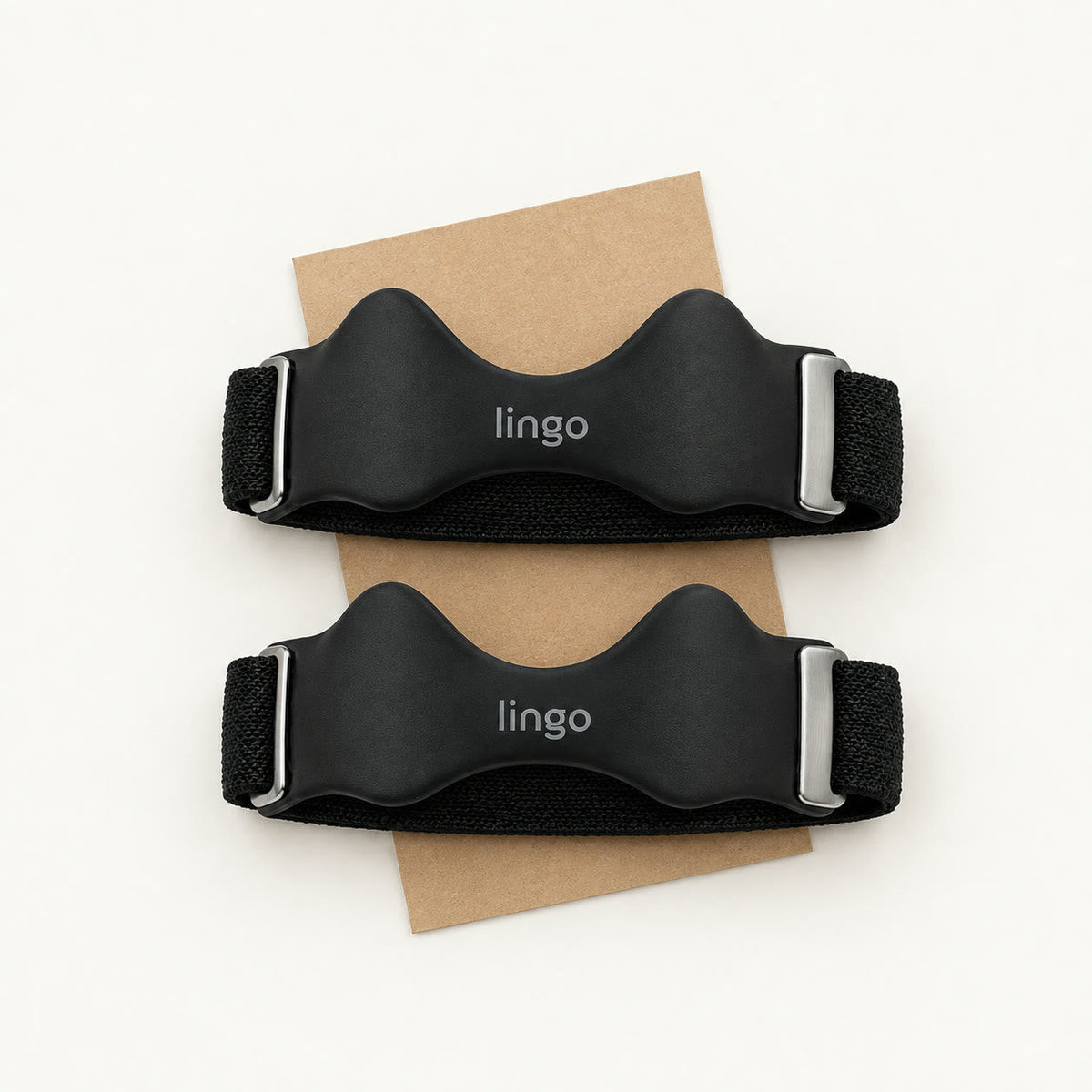
A patellar strap: a small, firm, contoured pad on an adjustable band. It sits just below the kneecap and applies focused pressure on the patellar tendon, which changes where the load goes when you bend, go down stairs or walk downhill. Many people find that more comfortable than wrapping the whole joint.
It is not a sleeve and not a brace. It does not squeeze your knee, it does not slide, it does not trap heat.
How do I put it on?
How do I put it on?
1. Sit down and find your kneecap with your fingers. 2. Place the pad about one inch below it, on the soft spot at the front of the leg — not on the kneecap. 3. Close the band so it is snug, never tight: you should be able to slip two fingers under it. 4. Stand up, take a few steps and re-adjust.
Loosen it if you feel numbness, tingling or throbbing. Do not sleep in it.
What's in the pack?
What's in the pack?
Two Lingo Knee Straps per pack — one for each knee, or one to wear and one to wash. One adjustable size; each strap fits the left or the right leg.
Care
Care
Close the hook-and-loop tab, hand wash in cool water with mild soap, and let it air dry. No bleach, no tumble dryer.

Lingo Knee Strap


It's Not the Whole Knee.
It's Where the Load Goes.
Going down a step, lowering yourself into a chair, walking downhill: every time, the big muscle on the front of your thigh brakes your body weight, and that pull runs through one tendon just under the kneecap. A sleeve squeezes everything around it. This strap presses on that one spot, and that changes where the load goes.
Try It for 30 DaysThe Brace in the Back of the Closet
Most people who end up here have already paid for something bigger: a $300 brace from a doctor's office that now lives in the back of a closet, a drawer of neoprene sleeves, shots that wore off after a few months. Wrapping your whole knee to press on one tendon is like wearing a winter coat to keep one hand warm.
Why people switch from sleeves, in the order we hear it.

The slideIt Ends Up Around Your Shin
A tube of stretchy fabric on a leg that gets narrower toward the ankle only goes one way. By the bottom of the stairs you are pulling it back up.

The back of the kneeIt Bunches and Scratches
Every time you sit, a sleeve folds into the crease behind your knee. Seams rub, fabric pinches, and that is usually the day it goes into the drawer.

The heatIt's a Wetsuit for One Joint
Neoprene is what divers wear to stay warm. Around a knee, in July, under trousers, it is hot and damp within the hour.

The lookEverybody Can See It
A big black brace announces itself under any pair of pants. A strap two inches tall does not. Roll your jeans down and it is gone.
"Won't It Slide Down Like Everything Else?"
Fair question. It is the first thing everyone asks, so here is the plain answer.
In the notch under the kneecap
Right below the kneecap the leg dips in, then the calf widens again. A narrow strap sits in that notch. A long sleeve has nothing to hold on to.
Firm and contoured, not flat elastic
The front pad is shaped to follow the leg and firm enough to keep its place. You set the band once with the hook-and-loop tab, to your own leg.
It is one of two things
Too loose, or too high. Snug it one notch, or slide it down off the kneecap. The placement guide below takes thirty seconds.
Two Inches of Strap. Not a Wetsuit.
It covers a thin band of skin under the kneecap and leaves the rest of your knee alone.

Where It Goes: One Inch Below
Placement is everything with a strap this small. Get this right and you have given it a real chance.
1. Find the kneecap
- Sit down, leg relaxed, knee bent
- Feel for the round, hard edge of the kneecap with your fingers
2. Go one inch below it
- Just under the kneecap there is a softer spot: that is the tendon
- Centre the pad there, on the front of the leg
- The most common mistake is wearing it ON the kneecap, where it presses on bone and does nothing
3. Snug, never tight
- Close the band so it does not move, and no more
- You should be able to slip two fingers under it
- Numbness, tingling or throbbing means it is too tight: loosen it
4. Stand up and walk
- Take the stairs once, then re-adjust if you need to
- Wear it for the things that load the knee: stairs, walks, a long day on your feet
- Take it off to sleep
Plain Answers. Including the Unflattering Ones.
What a patellar strap does, what the research actually covers, and who should skip it.
 What it actually doesPressure on one tendon. That's it.
 What the research coversAthletes with tendon trouble, not arthritis.
 Will it weaken my knee?It's a tool to stay active.
 Who should skip itWe would rather say it up front.
Why This One and Not the One in Your Drawer

It Presses on One Spot
Not the whole joint. One firm, contoured pad on the tendon just below the kneecap, which is where the load runs through when you bend.

It Stays Where You Put It
It sits in the notch under the kneecap and you set the band to your own leg. No tugging it back up at the bottom of every staircase.
No Heat, Nothing Behind the Knee
Two inches of strap instead of a neoprene tube. Nothing folds into the crease when you sit, nothing gets damp by lunchtime.
Nobody Knows It's There
Thin enough to vanish under jeans, slacks or leggings. You can wear it to dinner, to work or to church without announcing anything.

Two in Every Pack
Buy one, get one free: one for each knee, or one on and one in the wash. One adjustable size, and each strap fits either leg.

What Actually Differs
- Precision, Not Pressure — one firm pad on one tendon instead of a tight tube around everything
- It Stays On — because it sits in a notch, and because it is comfortable enough to keep wearing
- It Fits Your Day — on in seconds, under any pants, off at bedtime
- It Comes as a Pair — two straps in every pack
30 Days, Risk-Free
Wear it on your stairs, on your walk, through a long day on your feet. If it is not for you, contact us inside 30 days for a full refund — no questions asked.
Try It for 30 Days
One for each knee. One pair for each of you.
Every pack is Buy 1, Get 1 Free, so you always get two straps. Take two pairs and save more: one pair for you, one for your partner. Take three pairs and shipping is on us.
Choose My PackStraight Talk: What It Won't Do
Knee products oversell. A strap should not.
It does not treat arthritis
It does not treat, cure or reverse arthritis, it does not regrow cartilage, and it does not replace a doctor, physical therapy or surgery. Nothing you strap on does.
It does not replace strengthening
Strong thighs and hips are what protect a knee over the years. The strap is there to make staying active more comfortable while you do that work.
Some knees need a doctor first
Swelling, giving way, locking, or pain that is severe or persistent deserves a diagnosis. If that is you, talk to your doctor.
Questions People Ask Before They Buy
How can something this small do anything?
Does it help with arthritis?
Will it slide down?
How tight should it be? Can it cut off circulation?
Will one size fit my leg?
Can I wear it all day, under my clothes?
Will wearing it make my knee weaker?
Why are there two in the pack?
What if it doesn't work for me?
Individual results vary. The Lingo Knee Strap is a support accessory. It is not intended to diagnose, treat, cure or prevent any disease, and it does not replace medical advice, physical therapy or surgery. If your pain is severe or persistent, talk to your doctor.
Wear it snug, never tight. Remove it if you feel numbness, tingling, swelling or skin irritation. Do not sleep in it. Ask your doctor first if you have circulation problems or a history of blood clots.
Research cited: Lavagnino M et al., Sports Health 2011;3(3):296-302. de Vries A et al., Scand J Med Sci Sports 2016;26(10):1217-24. Demirbüken İ et al., Prosthet Orthot Int 2016;40(6):682-688. None of these studies tested the Lingo Knee Strap.
Two straps per pack. Free US shipping applies on the three-pack.